The product is built
The app, the server, the map and the staff moderation tooling are implemented and running. The presence-gated core loop works end to end.
Press kit
Wakestow turns the planet into a quiet, anonymous memory you can only read by being there.
No feed, no likes, no audience to perform for — built, running, and held back on purpose until it's safe to open. Here is what it is, how it works, where it stands and how to reach us.
In one paragraph
People leave anonymous memories tied to exact physical locations. Others find them only by standing where they were left — not from a couch, not from a feed, not from across the room. There are no likes, no comments, no followers, no profiles, no engagement metrics. The place comes first; the memory is its echo; the person who wrote it is almost invisible, and that is the point. A memory sealed to a bench in a city square waits, patient, for the right stranger to stand close enough. Sometimes that takes a day. Sometimes a decade. The waiting is the product.
The full case for why this is not a social network is on the home page: what we left out, and why.
Where it stands
The concept became a product: the app, the server, the map and the moderation tooling are built and running. The one thing that hasn't happened is the public launch, and that is a choice.
The app, the server, the map and the staff moderation tooling are implemented and running. The presence-gated core loop works end to end.
Not publicly released, and not on any app store yet. Access is closed while the safety floor is finished.
“Hush” — the near-black canvas, the single accent, the serif reserved for memory text, motion that settles rather than pops — is defined and shipped, not a mood board.
We won't set a date until moderation, erasure and the review path all clear. We would rather be late than be another app that hurt someone.
The architecture of honesty
Location is read only on an explicit action, in the foreground, and forgotten straight after. No identity, no profile, no location history, no IP joined to a memory. We could not deanonymise anyone if we tried, because there is nothing to join.
Anonymity without a feed still allows harm — targeted harassment at an address, doxxing, cruelty at a place of grief. Moderation is a first-class system here: automatic checks before anything is readable, a human queue, heavier friction in residential and sensitive zones, one-tap reporting. And a structural argument: removing the audience removed most of the reward.
We will never seed the world with machine-written memories to fake density. An empty place is allowed to be empty. The whole value is that a real person stood here and felt something; faking that is fraud against the reader.
Three paths, none of them ads: patronage from people who value it, permanence for memories that must outlast default retention, and institutional place-stewardship with archives, memorials and heritage bodies. Each is earned once the product proves itself. Never ads, never selling location.
Who it's for
Composites, not customers. They are how every product decision gets argued.
Twenty-nine, just walked out of the apartment she shared with someone for four years. She writes three sentences to no one, sets them down at the exact doorway, and walks away lighter.
Thirty-four, travels for work, walks unfamiliar cities at dusk to feel something. In a quiet square he opens the app not to write but to listen. One memory opens. The square is different now.
Forty-one, home for a parent's funeral. Walking past the hospital, she finds something a stranger left years ago that wrecks her in the best way. She leaves her own beside it.
For a story
Walk somewhere that means something to you. Stand still and imagine reading a stranger's truth in that exact spot — something set down years before you arrived, waiting for someone like you. That feeling, if it arrives, is the whole story. Everything else is documentation.
We are not asking you to love it. We are asking you to try it — and to describe what it was like to stand there, rather than what the buttons do.
The mark
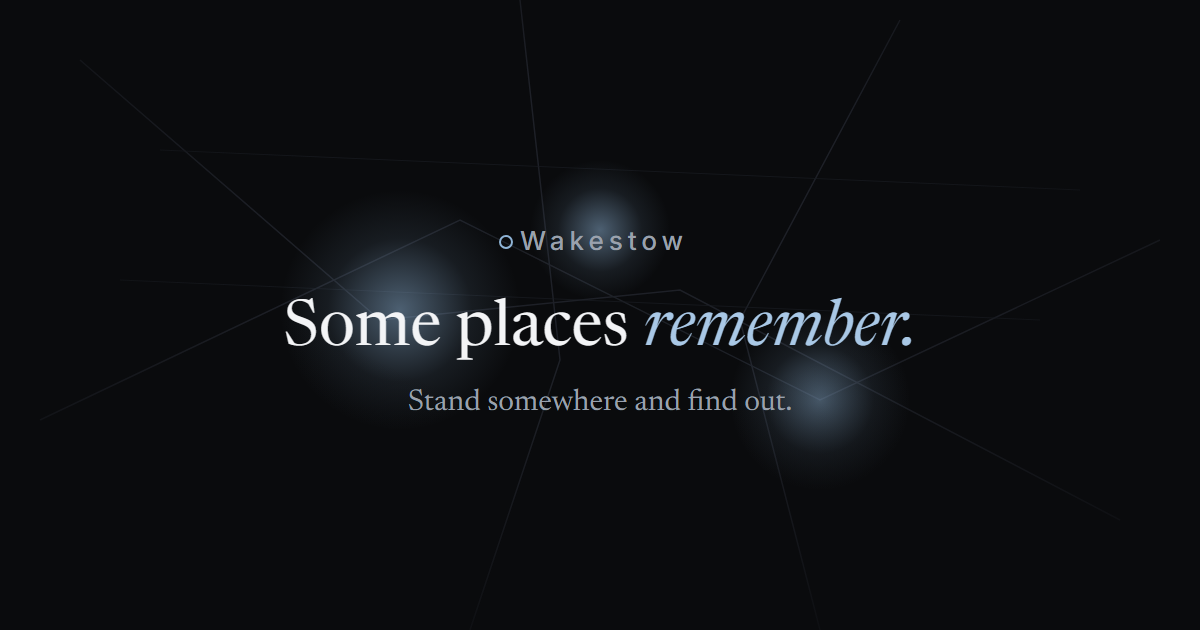
This is the only official image. Please don't recolour it, crop the wordmark out of it, or set it on a light background — the darkness is load-bearing.
Private testing
Interviews: yes, and in person if we can — in a place that means something, ideally. If you want early access to walk the product before it opens, say so and tell us which city you're in.
